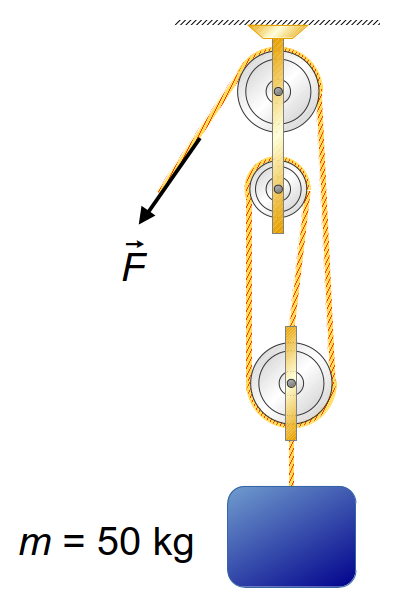
What is the force
\( \vec F \)
that an operator must apply to the rope to keep the 50 kg block in equilibrium?
Problem Data:
- Mass of the suspended block: m = 50 kg;
- Acceleration due to gravity: g = 9.8 m/s2.
Problem Diagram:
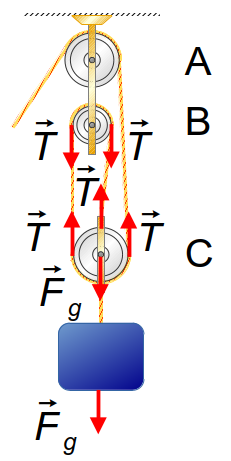
The gravitational force
\( \vec F_g \)
of the block is transmitted to the support of pulley C. The tension force
\( \vec T \)
is equally divided between the two sides of pulley C. The rope on the left side of pulley C transmits
the tension force
\( \vec T \)
to the left side of pulley B, therefore the tension force on the right side of pulley B is also
equal to
\( \vec T \).
The rope on the right side of pulley B transmits the tension force
\( \vec T \)
to pulley C (Figure 1).
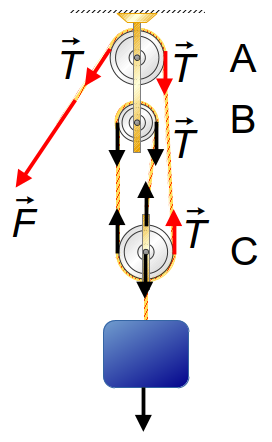
The rope on the right side of pulley C transmits the tension force
\( \vec T \)
to the right side of pulley A, therefore the tension force on the left side of pulley A is also
equal to
\( \vec T \).
Therefore, the force
\( \vec F \)
applied by the operator is equal to
\( \vec T \)
(Figure 2).
Solution:
The gravitational force is given by
\[
\begin{gather}
\bbox[#99CCFF,10px]
{F_g=mg}
\end{gather}
\]
the gravitational force of the block will be
\[
\begin{gather}
F_g=(50\:\mathrm{kg})\times(9.8\;\mathrm{m/s^2}) \\[5pt]
F_g=490\;\mathrm N
\end{gather}
\]
The three tension forces equal to
\( \vec T \)
in the ropes of pulley C balance the gravitational force of the block (Figure 1). Applying the equilibrium
condition, the summation of the forces must be equal to zero.
\[
\begin{gather}
\bbox[#99CCFF,10px]
{\sum \vec F=0}
\end{gather}
\]
substituting the gravitational force found above, in magnitude.
\[
\begin{gather}
T+T+T-F_g \\[5pt]
3T=F_g \\[5pt]
T=\frac{F_g}{3} \\[5pt]
T=\frac{490\;\mathrm N}{3} \\[5pt]
T\approx 163,3\:\mathrm N
\end{gather}
\]
As the force
\( \vec F \)
exerted by the operator is equal to the tension force
\( \vec T \)
(Figure 2).
\[
\begin{gather}
F=T
\end{gather}
\]
\[
\begin{gather}
\bbox[#FFCCCC,10px]
{F=163,3\;\mathrm N}
\end{gather}
\]
 DE
DE
 ES
ES
 FR
FR
 IT
IT
 PT-BR
PT-BR