 DE
DE
 ES
ES
 FR
FR
 IT
IT
 PT-BR
PT-BR
A man with a mass equal to 70 kg crosses a rope bridge over a river, as shown in the figure. The angles that the
rope makes with a horizontal line, at the position where the man is, are equal to 15° and 25°. What are the
tension forces acting on the rope?
Data: cos 15° = 0.9659, sin 15° = 0.2419, cos 25° = 0.9063, sin 25° = 0.4226.
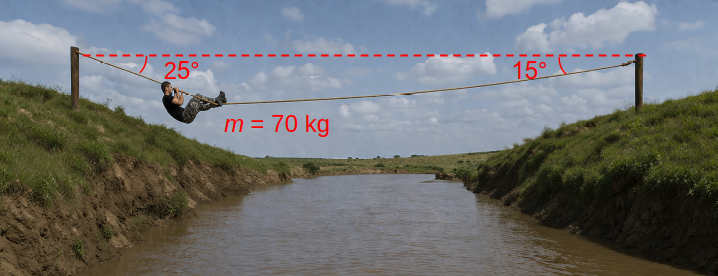
Problem Data:
- Mass of the man: m = 70 kg;
- Angle 1 between the rope and the horizontal: α1 = 25°;
- Angle 2 between the rope and the horizontal: α2 = 15°;
- Acceleration due to gravity: g = 9,8 m/s2.
Problem Diagram:
For simplicity, we consider that all the weight force of the man is applied at a single point of the rope
(Figure 1-A).
The forces acting on the system are the weight force of the man
\( \vec P \),
which points downward, and the tensions in the ropes. The rope on the left side makes an angle of 25° with the
horizontal; this is the same angle formed between the tension force 1,
\( {\vec T}_1 \),
and the x-axis. The rope on the right side makes an angle of 15° with the horizontal; this is the same angle
formed between the tension force 2,
\( {\vec T}_2 \),
and the x-axis.
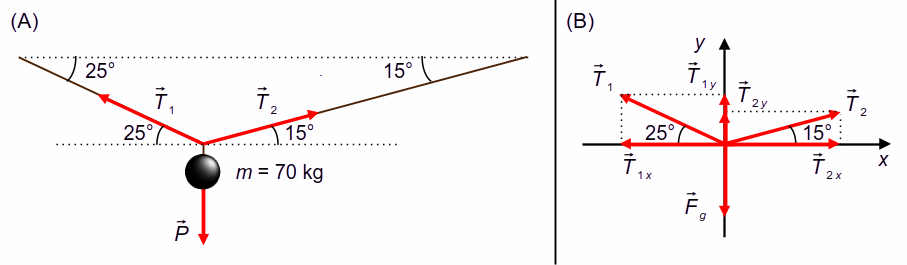
We draw the forces in an xy coordinate system and decompose the forces in these directions (Figure 1-B). The weight force has only a component in the negative y direction. The tension force 1 has a component in the positive x direction and a component in the negative y direction. The tension force 2 has a component in the positive x direction and a component in the positive y direction.
Solution::
The gravitational force is given by
the gravitational force of the man will be
Since the system is in equilibrium, the resultant of the forces acting on it is equal to zero.
x direction: \( -{\vec T}_{1x}+{\vec T}_{2x}=0 \)
y direction: \( -\vec P+{\vec T}_{1y}+{\vec T}_{2y}=0 \)
in magnitude we have
substituting the given values for the sine and cosine and the weight calculated above, these equations form a system of two equations with two unknowns (T1 and T2).
from the first equation of the system (I), we isolate the value of T1.
substituting equation (II) into the second equation of the system (I), we obtain the value of T2.
Substituting the value found above into equation (III), we obtain the value of T1.