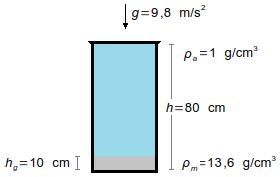
Un recipiente cilindrico contiene mercurio fino a un’altezza di 10 cm e poi acqua fino all’altezza di 80 cm, misurate
a partire dalla base. Le masse specifiche del mercurio e dell’acqua sono, rispettivamente, 13,6 g/cm3 e
1 g/cm3. Determinare la pressione sul fondo del recipiente.
Dati del problema:
- Densità del mercurio: ρm = 13,6 g/cm3;
- Altezza della colonna di mercurio: hm = 10 cm;
- Densità dell’acqua: ρa = 1 g/cm3;
- Altezza dell’acqua a partire dalla base: h = 80 cm;
- Accelerazione di gravità: g = 9,8 m/s2.
Schema del problema:
Soluzione:
Innanzitutto, dobbiamo convertire le densità dell’acqua e del mercurio, date in grammi per centimetro cubo
(g/cm3), in chilogrammi per metro cubo (kg/m3) e le altezze date in centimetri (cm) in
metri (m), usati nel Sistema Internazionale di Unità di Misura (SI).
\[
\begin{gather}
\rho_m=13,6\;\mathrm{\frac{\cancel g}{cm^3}}\times\mathrm{\frac{1\;kg}{1000\;\cancel g}}\times\mathrm{\frac{(100\;cm)^3}{(1\;m)^3}}=13,6\;\mathrm{\frac{1}{\cancel{cm^3}}}\times\mathrm{\frac{1\;kg}{1\cancel{000}}}\times\mathrm{\frac{1 000 \cancel{000}\;\cancel{cm^3}}{1\;m^3}}=13600\;\mathrm{\frac{kg}{m^3}} \\[10pt]
\rho_a=1\;\mathrm{\frac{\cancel g}{cm^3}}\times\mathrm{\frac{1\;kg}{1000\;\cancel{g}}}\times\mathrm{\frac{(100\;cm)^3}{(1\;m)^3}}=1\;\mathrm{\frac{1}{\cancel{cm^3}}}\times\mathrm{\frac{1\;kg}{1\cancel{000}}}\times\mathrm{\frac{1 000 \cancel{000}\;\cancel{cm^3}}{1\;m^3}}=1000\;\mathrm{\frac{kg}{m^3}} \\[10pt]
h_m=10\;\mathrm{\cancel{cm}}\times \mathrm{\frac{1\;m}{100\;\cancel{cm}}}=0,1\;\mathrm m \\[10pt]
h=80\;\mathrm{\cancel{cm}}\times \mathrm{\frac{1\;m}{100\;\cancel{cm}}}=0,8\;\mathrm m
\end{gather}
\]
La pressione della colonna di liquido, pc, è data dalla Legge di Stevino
\[
\begin{gather}
\bbox[background:#99CCFF; padding:10px; border-radius:10px;]
{p_c=\rho gh} \tag{I}
\end{gather}
\]
Per il mercurio pm
\[
\begin{gather}
p_m=\rho_m g h_m \\[5pt]
p_m=13600\times 9,8\times 0,1 \\[5pt]
p_m=13328\;\mathrm{Pa} \tag{II}
\end{gather}
\]
L’altezza della colonna d’acqua, ha, sarà la differenza tra l’altezza misurata a partire dalla
base e l’altezza della colonna di mercurio
\[
\begin{gather}
h_a=h-h_m \tag{III}
\end{gather}
\]
Applicando l’equazione (I), abbiamo la pressione della colonna d’acqua pa
\[
\begin{gather}
p_a=\rho_a g h_a \tag{IV}
\end{gather}
\]
sostituendo l’equazione (III) nell’equazione (IV)
\[
\begin{gather}
p_a=\rho_a g\;(h-h_m) \\[5pt]
p_a=1000\times 9,8\times(0,8-0,1) \\[5pt]
p_a=9800\times 0,7 \\[5pt]
p_a=6860\;\mathrm{Pa} \tag{V}
\end{gather}
\]
La pressione totale sul fondo del recipiente è data dalla somma delle equazioni (II) e (V)
\[
\begin{gather}
p=p_m+p_a \\[5pt]
p=13328+6860
\end{gather}
\]
\[
\begin{gather}
\bbox[background:#FFCCCC; padding:10px; border-radius:10px;]
{p=20188\;\mathrm{Pa}}
\end{gather}
\]
 DE
DE
 EN
EN
 ES
ES
 FR
FR
 PT-BR
PT-BR