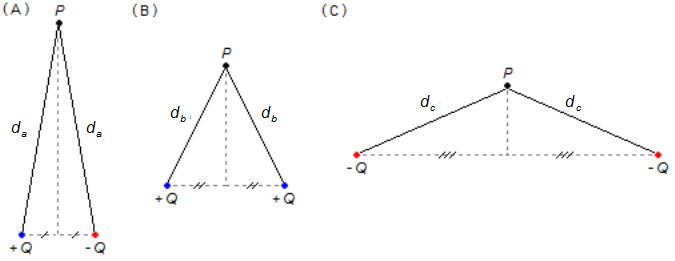
Bestimmen Sie das elektrische Potential am Punkt P in den Fällen (A), (B) und (C) der untenstehenden
Abbildung, wobei gilt Q = 6 μC,
\( k_e=9\times 10^9\;\mathrm{\frac{N.m^2}{C^2}} \)
und die Abstände der Ladungen vom Punkt P gegeben sind:
a) da = 0,3 m;
b) db = 0,1 m;
c) dc = 0,2 m.
Gegebene Daten:
- Betrag der Ladungen: Q=6 μC=6×10⁻⁶ C;
-
Coulomb-Konstante:
\( k_e=9\times 10^9\;\mathrm{\frac{N.m^2}{C^2}} \) .
Lösung:
Das elektrische Potential an einem Punkt aufgrund mehrerer Ladungen ergibt sich aus der algebraischen
Summe der Potentiale jeder einzelnen Ladung
\[
\begin{gather}
\bbox[background:#99CCFF; padding:10px; border-radius:10px;]
{V=k_e\frac{Q_1}{d_1}+k_e\frac{Q_2}{d_2}+...+k_e\frac{Q_n}{d_n}}
\end{gather}
\]
a) Für
\( Q_1=+6\times 10^{-6}\;\mathrm C \) ,
\( Q_2=-6\times 10^{-6}\;\mathrm C \)
und
\( d_1=d_2=d_a=0,3\;\mathrm m \)
\[
\begin{gather}
V=9\times 10^9\times\frac{6\times 10^{-6}}{0,3}+9\times 10^9\times\frac{-6\times 10^{-6}}{0,3} \\[5pt]
V=180\times 10^3-180\times 10^3
\end{gather}
\]
\[
\begin{gather}
\bbox[background:#FFCCCC; padding:10px; border-radius:10px;]
{V=0}
\end{gather}
\]
b) Für
\( Q_1=Q_2=+6\times 10^{-6}\;\mathrm C \)
und
\( d_1=d_2=d_b=0,1\;\mathrm m \)
\[
\begin{gather}
V=9\times 10^9\times\frac{6\times 10^{-6}}{0,1}+9\times 10^9\times\frac{6\times 10^{-6}}{0,1} \\[5pt]
V=2\times 540\times 10^3
\end{gather}
\]
\[
\begin{gather}
\bbox[background:#FFCCCC; padding:10px; border-radius:10px;]
{V=1,08\times 10^6\;\text V}
\end{gather}
\]
c) Für
\( Q_1=Q_2=-6\times 10^{-6}\;\mathrm C \)
und
\( d_1=d_2=d_c=0,2\;\mathrm m \)
\[
\begin{gather}
V=9\times 10^9\times\frac{\left(-6\times 10^{-6}\right)}{0,2}+9\times 10^9\times\frac{\left(-6\times 10^{-6}\right)}{0,2} \\[5pt]
V=\cancel 2\times\left(-\frac{54\times 10^3}{\cancel 2\times 10^{-1}}\right)
\end{gather}
\]
\[
\begin{gather}
\bbox[background:#FFCCCC; padding:10px; border-radius:10px;]
{V=-5,4\times 10^5\;\mathrm V}
\end{gather}
\]
 EN
EN
 ES
ES
 FR
FR
 IT
IT
 PT-BR
PT-BR